 The recent performance by the USA Men's Basketball Team in the 2006 FIBA World Championshipsand the 2004 Olympic Games serves as a cold reminder of how the three-point shot has influencedmodern basketball. While the NBA game seems to supply us with bigger and better athletes everyyear, there is a noticeable lack of good American shooters in the pro game. How does this happenwhen high school and college players have been cranking up a record number of “threes” in recent years? The recent performance by the USA Men's Basketball Team in the 2006 FIBA World Championshipsand the 2004 Olympic Games serves as a cold reminder of how the three-point shot has influencedmodern basketball. While the NBA game seems to supply us with bigger and better athletes everyyear, there is a noticeable lack of good American shooters in the pro game. How does this happenwhen high school and college players have been cranking up a record number of “threes” in recent years?
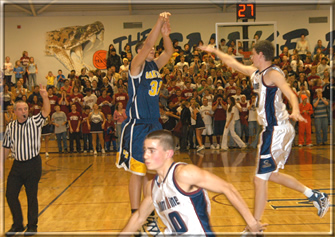
“Dunking and Threes” – that seems to be the essence of modern basketball in the United Statestoday. If a team can't get a highlight-reel dunk on the fast break, then someone immediately throws up a 20-footer. The three point shot was adopted about 20 years ago to open up the inside game, but now it seems to be the main culprit in the demise of good post play and good shooters. Ryan Anderson of Oak Ridge vs
Union Mine's AJ Carson in 2006
But wait, you say! How can the three-point shot be detrimental to shooting? That's easy. The reward is too big for something that seems to be relatively easy – three points for a twenty-foot shot. Before the adoption of the three-point line, a shooter missing a couple of twenty-footers would be discouraged from shooting that shot again. His coach would encourage him to use the post player or position himself in an area that would lead to a higher percentage shot. But not now!Today's coaches let weak shooters throw up long shots in hopes of the “big pay-off” – a quick three points.
While a two-point shooter needs to make one of every two shots to average a point per attempt, a three point shooter only needs to make one of three shots. Most kids will tell you they certainly can make one of three, and most coaches are inclined to take that risk and let them shoot “the three.” But there are just too many teams shooting under 30% from beyond the three point arc today. Everyone seems to have the “green light” to fire it up, even if they haven't developed an outside shooting touch. Consequently, we have an abundance of “three-point shooters” but not very many “three-point makers.”
And how has the shot opened up the inside game and helped the post man? It hasn't! Take a look at the lack of big men in the NBA and in college basketball who can score inside. Now we have 7-footers who want to stand outside and shoot “the three” along with all the smaller players. Very few big men want to hang out in the low post and battle for a good inside shot anymore.
So how can we develop better shooters again in this country? One way might be to eliminate the three-point shot and get back to the original game of basketball. After all, do the Giants get an extra run whenever Barry Bonds hits a 450-foot home run instead of a 340-foot one? Does a kicker in the NFL get 4 points for kicking a 40-yard field goal and only 3 points for a 20-yard one? Of course not. Drop the three-point shot and coaches will again reward the good shooters with more opportunities to shoot, they will encourage others to become better midrange shooters, and they will again develop an inside game for their big men.
And what about the rest of the world? I say let them keep widening the lane, throwing up “threes,” and playing zone defenses. If we get back to playing basketball the way it was meant to be played, from the inside-out, we can again whip them every time.
When it comes to scoring “three,” personally, I like the old-fashioned way. Go to the basket, draw contact, hit the field goal, then walk to the free throw line and earn that third point. The Three Ain't for Me.
Terry Battenberg |